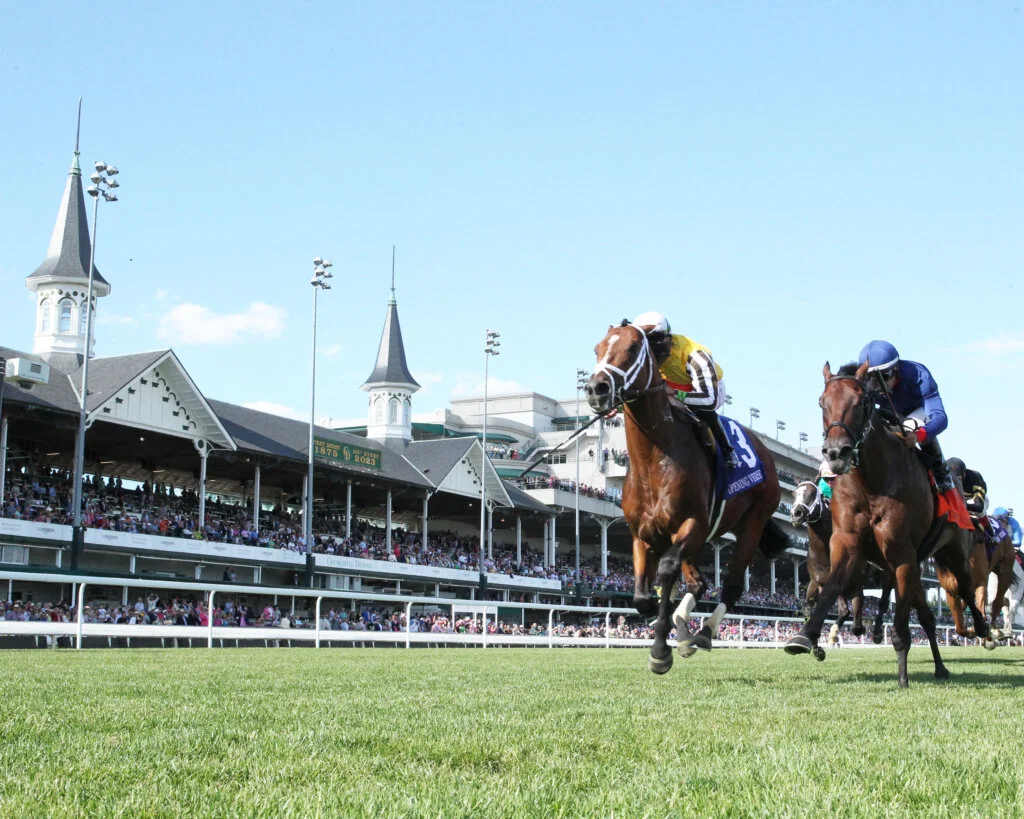
The Churchill Downs footprint
Churchill Downs is one of the venues we work on regularly in Louisville.
Projects at the downs start with its published floor plan, dock schedule, and service-order deadlines.
What drives the Louisville calendar
Trade show weeks in Louisville compress decisions.
5 in the world and No.
How Louisville floor operations work
Labor in Louisville runs venue-by-venue, not citywide.
Practical planning rules for the downs in Louisville: Regional projects in Southern Indiana or Lexington are extensions of the Louisville operating radius, each with its own venue procedures. Labor requirements vary by venue, event manual, and current service-partner rules.
Scope at Churchill Downs
The handoffs on a project at the downs matter almost as much as the line items. Design has to hand a build-ready drawing to fabrication. Every handoff is a place quality can drop.
Scope boundary is as important as scope inclusion.
How a project runs
Venue coordination comes next.
Install days are owned by a single on-site lead.
During show hours, the booth is a live operating space.
That document drives the next booking.
Pricing and scheduling
Cost scales with how it is built, how big it is, what the venue charges for its own services, what the graphics look like, how far the crates travel, and how many days the team stays on-site.
Lead time drives everything. Custom: 16 to 20 weeks. Rental: 8 to 12.
What a successful project looks like
Trade show ROI is measured at the lead and pipeline level.
A week after the show, the booth's actual floor performance is already clearer than any pre-show projection. We document those observations alongside the technical closeout so the next cycle inherits real signal, not nostalgia.
What makes our work different
Trade Show Services of Louisville keeps the work local.
The difference from a national vendor shows up at the dock.
Common questions
How does labor work in Louisville?
It runs venue by venue.
How much lead time is ideal?
Custom builds run best with 16 to 20 weeks of lead time. Rentals take 8 to 12 weeks.
What information kicks off a project?
The show, the venue, the booth number, the dates, and a target budget range. From those, an initial scope and a realistic cost come back within a few days.
Who runs the booth on-site?
One named show-site lead runs the install, the show hours, and the strike. That person carries the floor plan and the punch list from crates to doors and reports up once a day.
Can the booth travel to the next city on our calendar?
Same structure, swappable graphics, standard crates.
What happens if something breaks during show hours?
The on-site lead handles it.